Complete Solar System Design Guide for Homes and Businesses
Introduction
Designing a reliable solar power system goes beyond buying panels and batteries — it’s about ensuring every component works together to deliver steady power day and night.
Whether for your home, office, or factory, a properly designed solar system determines your energy efficiency, cost savings, and long-term durability.
In this guide, Solarzone Nigeria explains everything you need to know to design a complete solar system that fits your energy needs and budget.
1️⃣ Understand Your Energy Consumption
Before anything else, determine your daily energy usage.
Steps:
-
List all electrical appliances (fans, lights, fridge, TVs, etc.).
-
Check their power ratings (in watts).
-
Multiply the watts by the number of hours each device runs daily.
-
Add the total — that’s your daily energy demand in Wh (watt-hours).
💡 Example:
If your total daily energy use is 8,000 Wh, you’ll need a solar setup that generates at least that amount (plus 20–30% margin for losses).
👉 Solarzone offers free load analysis to help determine your exact power requirements before installation.
2️⃣ Select the Right System Type
There are three main solar system types to choose from:
| Off-Grid System | Works independently without PHCN | Remote areas, farms, and rural homes |
| Hybrid System | Combines solar + battery + PHCN/generator | Homes, offices with intermittent power |
| Grid-Tied System | Connected directly to the grid | Businesses and industries with steady supply |
💼 Solarzone installs all system types based on your power goals and location.
3️⃣ Choose the Right Solar Components
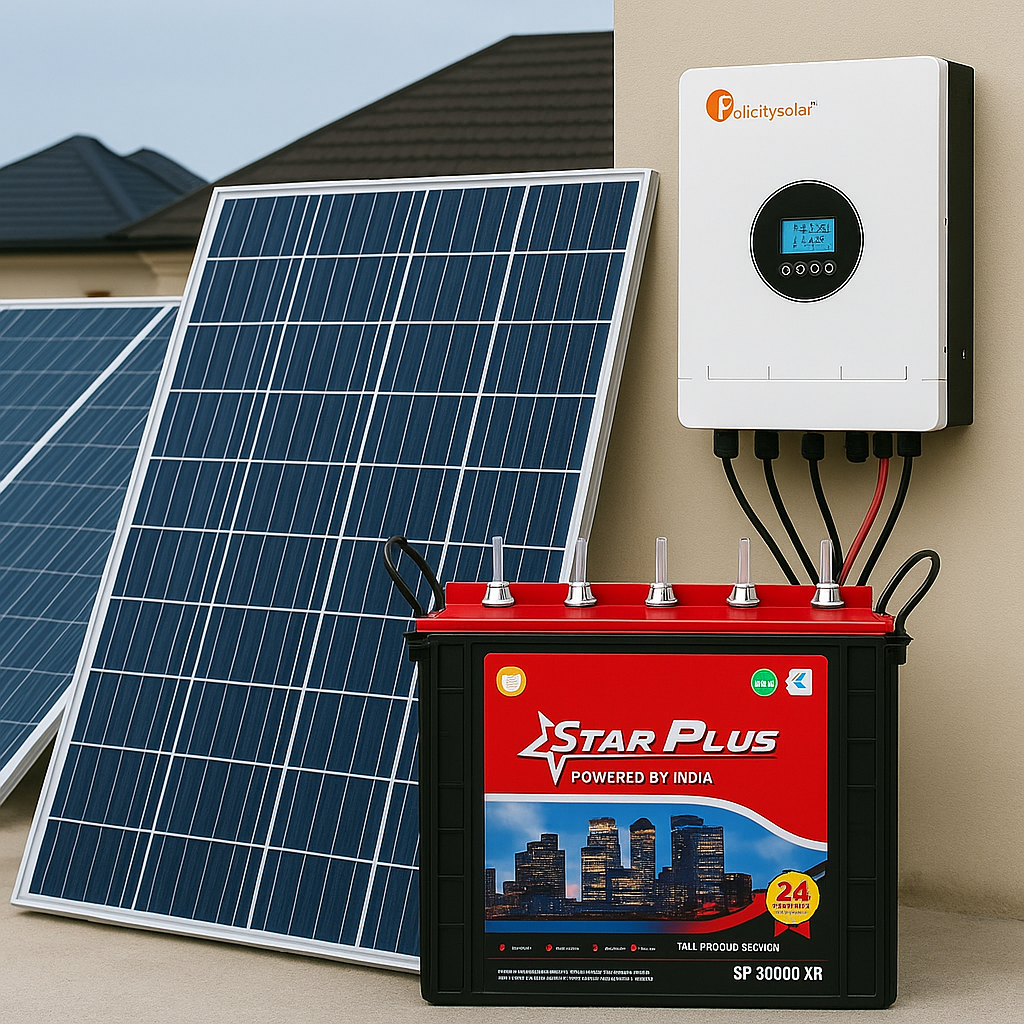
A complete solar system includes the following components:
🔹 1. Solar Panels
Convert sunlight into DC electricity.
✅ Choose high-efficiency monocrystalline panels for better performance in limited space.
Solarzone supplies premium panels like Africell 300W, 550W, and 600W — built for Nigerian conditions.
🔹 2. Inverter
Converts DC power from panels/batteries to AC power for appliances.
✅ Choose pure sine wave inverters for sensitive electronics.
Solarzone offers Felicity and Luminous inverters that guarantee stable output and long life.
🔹 3. Charge Controller
Regulates power between panels, batteries, and inverter.
✅ Opt for MPPT controllers for higher efficiency.
🔹 4. Battery Bank
Stores energy for use at night or during low sunlight.
✅ Choose deep-cycle or tubular batteries (200Ah/12V) for durability.
Solarzone provides Amaron Quanta and Zetrex Tubular batteries with excellent lifespan.
🔹 5. Mounting & Cabling
Proper roof mounting and quality cables ensure system stability and safety.
✅ Solarzone uses corrosion-resistant aluminum mounts and professional-grade wiring.
4️⃣ Calculate Your Solar System Size
A simple design rule is:
Total Solar Panel Power=Daily Energy Usage (Wh)Average Sunlight Hours (h)\text{Total Solar Panel Power} = \frac{\text{Daily Energy Usage (Wh)}}{\text{Average Sunlight Hours (h)}}Total Solar Panel Power=Average Sunlight Hours (h)Daily Energy Usage (Wh)If your home uses 8,000Wh per day and your location gets 5 hours of sunlight,
then you need about 1,600W (1.6kW) of solar panels.
💡 Solarzone engineers perform these calculations accurately during your system design phase.
5️⃣ Battery Sizing
Battery storage determines how long you can use electricity at night.
Battery Capacity (Ah)=Daily Energy Usage (Wh)Battery Voltage (V)×Depth of Discharge\text{Battery Capacity (Ah)} = \frac{\text{Daily Energy Usage (Wh)}}{\text{Battery Voltage (V)} \times \text{Depth of Discharge}}Battery Capacity (Ah)=Battery Voltage (V)×Depth of DischargeDaily Energy Usage (Wh)For example:
8,000Wh ÷ (12V × 0.8) = 833Ah → roughly 4 × 200Ah batteries.
✅ Solarzone designs your battery bank for 1–2 days of backup power.
6️⃣ Installation Design & Layout
A safe, efficient system layout includes:
-
Panels installed facing south at an optimal tilt angle
-
Minimal shading from trees or structures
-
Proper grounding and lightning protection
-
Adequate ventilation for inverters and batteries
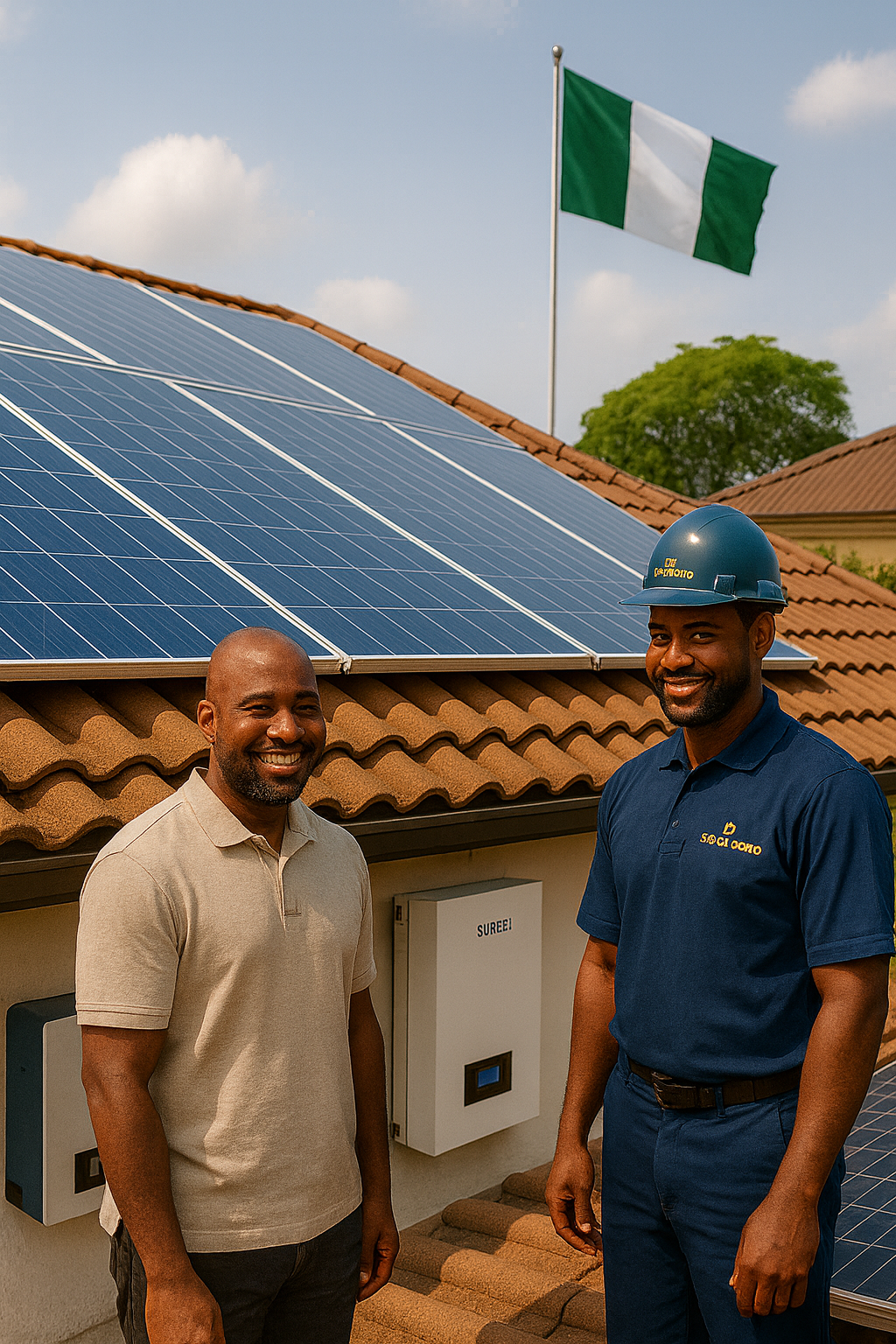
🔧 Solarzone’s certified technicians ensure every installation follows international safety and efficiency standards.
7️⃣ Monitoring & Maintenance
To maintain peak performance:
-
Clean your panels every 2–3 months
-
Inspect connections for corrosion or wear
-
Check battery water levels (if not sealed)
-
Monitor inverter readings regularly
💼 Solarzone offers maintenance packages that cover system inspection, cleaning, and performance optimization.
Why Choose Solarzone for Solar Design and Installation
✅ 10+ years of renewable energy experience
✅ Nationwide delivery and installation
✅ Certified engineers and warranty-backed products
✅ Custom solar designs for homes, offices, and industries
✅ Ongoing maintenance and after-sales support
🌍 With Solarzone, you get more than power — you get reliability, efficiency, and long-term value.
Final Thoughts
Designing a solar system is a technical process that determines how much energy you save and how long your system lasts.
With Solarzone Nigeria, every project starts with accurate analysis, quality products, and expert installation — ensuring you enjoy stable and sustainable electricity all year round.
💥 Call to Action:
⚡ Ready to design your perfect solar system?
Get a free consultation and quote from Solarzone Nigeria today.
📞 Call/WhatsApp: +234 [09091394722]